Part 1 can be found at https://zetier.com/vulnerability-research-unofficial-playbook-part-1/.
Tactic #11: Here’s Johnny
Secure software is supposed to have a few narrow doors where dirty, untrusted input officially becomes clean, trusted data. Those are the trust boundaries. Find them, then poke them like you hate them:
- Missing check? Integer overflow? Wrong encoding? Pointer confusion?
- Multiple sneaky ways to bypass the door?
- No boundaries at all? → Jackpot, the whole app is a free-for-all
- Time-of-check to time-of-use (or TOCTOU if you like abbreviations) races love living right on the line via racing two threads
Audit every validation at these choke points like they personally owe you rent. One sleepy strcmp or forgotten bounds check and boom—the whole security model faceplants.
Tactic #12: Closing Time
Most memory corruption bugs don’t happen during happy, normal usage. They hide in the messy moments when the program is desperately trying to clean up its own mess during connection close, teardown, shutdown, error recovery, object destruction, session destroy, or resource release. That’s when the developers are tired, the code is full of “finally” blocks, and everyone is praying nothing explodes.
The classic pattern to hunt:
- Find a place where an object/resource gets allocated or referenced early on
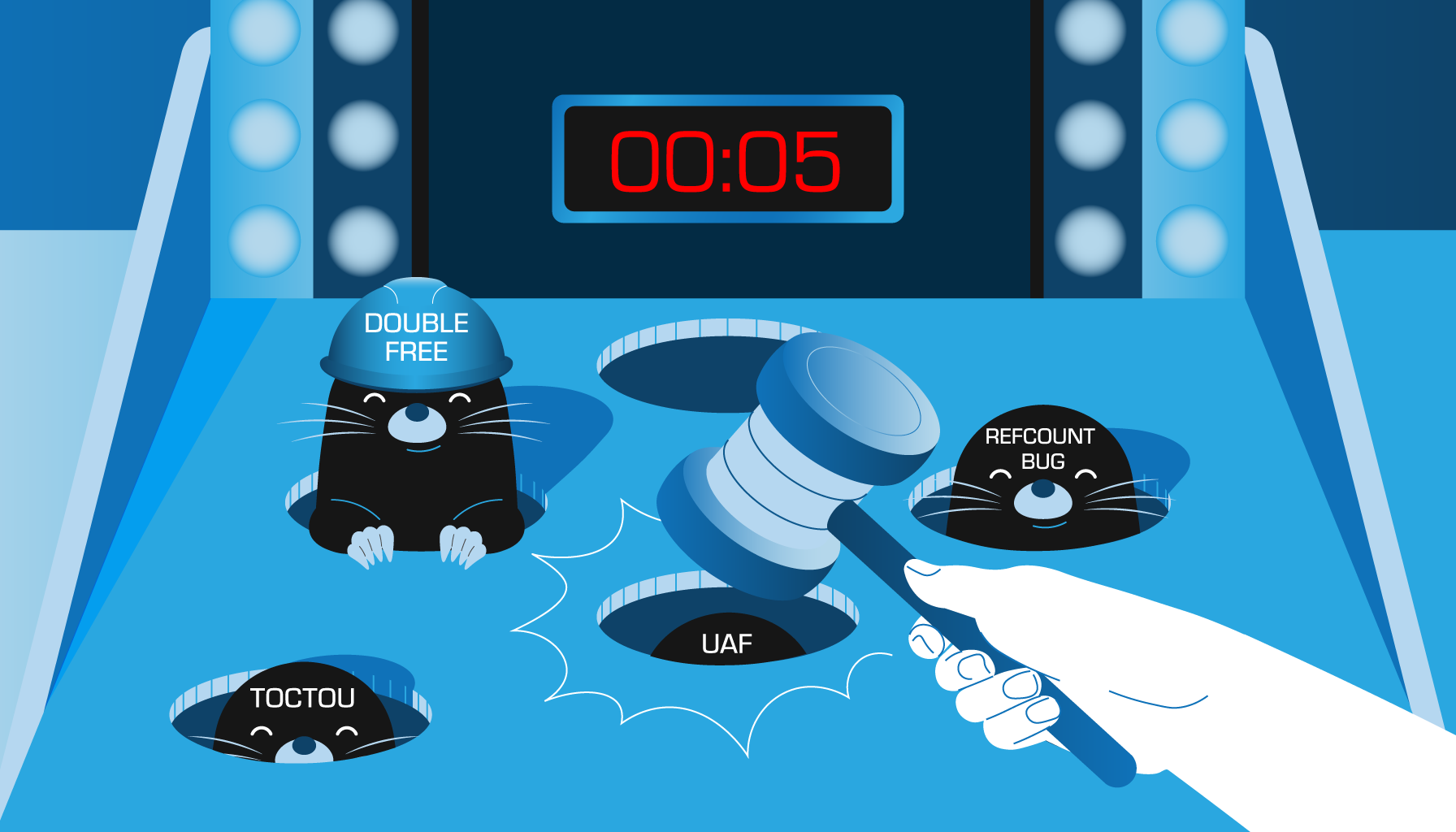
- Then find where it gets freed / destroyed / released / invalidated (usually in a destructor,
close(), cleanup handler, error path, or shutdown sequence) - Now try to race something between those two points:
- Trigger a new use / re-reference of the object after the teardown started but before the free actually finishes
- Force a double-free by racing two teardown paths
- Sneak in a use-after-free by delaying the teardown slightly (slow network, debugger, high load)
- Make the same object get re-allocated and reused while the old pointer is still floating around in some unlucky thread
Favorite playgrounds for these races:
- Connection/session close handlers
- Object pool / cache eviction
- Error unwind paths (exception handlers, goto cleanup)
- Signal handlers or async shutdown
- Multi-threaded resource release (especially with refcounts or smart pointers)
- Library unload / plugin destroy sequences
Quick hunting checklist:
- Ask: “Can anything still touch the object after a
free()/delete()/CloseHandle()/release()/destroy()/unregister()?” - Ask: “Can anything still touch this thing after that line starts executing?”
- Ask: “Is there any way to delay that free just long enough for me to sneak in another use?”
- Ask: “Can two threads / requests / callbacks hit the teardown at the same time?”
Race conditions during teardown are beautiful because they’re almost never fuzzed properly, rarely covered by unit tests, and developers usually only test the “clean close” case on a single thread with good timing. Mess with the timing, add threads, force errors, slow things down—and watch the use-after-free or double-free party start.
Tactic #13: Hold My Beer
C code still loves its manual refcounting for every pointer holding a ref to an object. Every hand-rolled _retain() / _release() is a tiny opportunity for joy (or tears). Pick an interesting object type and count its refcount.
You’re looking for:
- Increments / decrements that aren’t atomic (no atomic_fetch_add, no InterlockedIncrement, just plain ++rc in a multithreaded world → race → boom)
- Refcount changes that aren’t locked when they clearly should be (no mutex, no spinlock, just vibes)
- Happy-path increments that mysteriously never get matched by a decrement in the error / early-return / “goto cleanup” paths
- Paths that decrement twice on failure (hello double-free) or forget to decrement at all (hello leak)
- Refcount ever dipping to zero…and then getting used anyway a few lines later (classic UAF speedrun)
Simple, mechanical, and surprisingly devastating in real-world C code bases. Note that if the code has saturation on for recounting, overflowing won’t work.
Tactic #14: The New New
New features are bug candy: freshly written, barely reviewed, and usually untouched by serious hunters yet.
They show up in recent changelogs, release notes, or git commits with words like new, added, support for, experimental, or shiny marketing hype. Jump straight there:
- Brand-new parsers, endpoints, file formats, protocol extensions, auth flows, config options
- Anything guarded by a recently flipped feature flag
- Code added in the last 1-6 months
Why it works: Zero historical audits, low fuzz coverage, and developers still in the “this is perfect” honeymoon phase.
Quick reality check: These bugs often have a short lifespan—new features get the most public eyes and fastest patching cycles. Move fast, or that juicy bug might be gone by next week’s hotfix.
First to the nursery usually wins the easiest bugs.
Tactic #15: Started From the Bottom Now We Here
In big IOCTL dispatchers (drivers, kernel modules, etc.), skip the top of the switch/case or dispatch table—that code has been beaten to death for years.
Jump straight to the bottom:
- New commands are almost always added at the end (highest command numbers, newest case labels, last array entries)
- They get way less review, almost no fuzzing, and zero historical attention
- The dev was usually in a rush when he wrote them
Tactic #16: Shared Object Showdown
Any time you see multithreading (threads, thread pools, async callbacks, shared objects, concurrent queues), immediately switch to race-condition hunting mode. Target any object that is shared between threads. Multithreaded code is a goldmine for bugs that are insanely hard to catch:
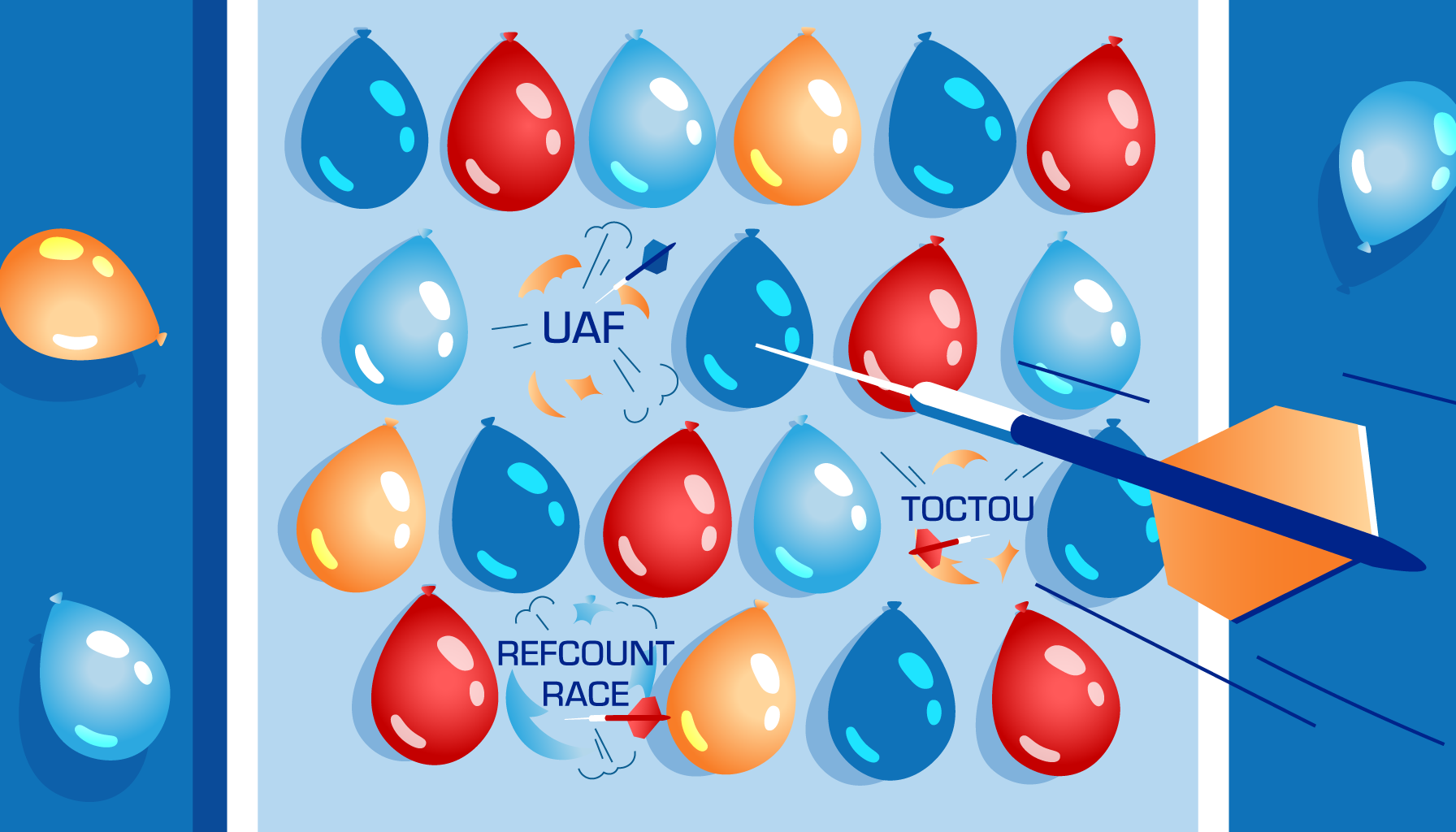
- use-after-free
- double-free
- data races on non-atomic vars
- TOCTOU
- refcount races
- wrong lock ordering
Single-threaded code gets hammered by fuzzers and reviews. Races? They only appear under weird timing or load—so most hunters never find them.
Quick reflex:
- Spot threads and ask “what’s shared?”
- Check: atomic? locked? sequenced?
- Try to force collisions: concurrent requests, sleeps, stress loops, high load.
Races are painful to repro, but when you nail one it’s usually catastrophic—and almost nobody else cared to look.
Tactic #17: I’m Not Saying She’s a Gold Digger
After you’ve found one real bug in a piece of code, if it doesn’t work out for exploitation, keep looking in that area. Bugs are like gold nuggets—they cluster together.
Here are some possible reasons to explain this:
- The same developer wrote the neighboring functions
- The same assumptions, copy-pasted patterns, and “this should be safe” vibes are repeated
- The same lack of review, the same missing tests, the same rushed deadline applied to the whole module
- The same custom allocator / deserializer / refcount wrapper / string handling macro is used everywhere nearby
Keep digging in that cluster. The next bug is usually sitting right next door, just waiting for someone to notice it, too.
Tactic #18: Liar, Liar, Pants On Fire
Source code is adorable. It’s clean, it’s readable, it has nice variable names and helpful comments. It also lies to your face on a regular basis.
Here’s why you should always check the disassembly before you start dreaming about your shiny, new bug:
- Compiler security features (stack canaries, safe stack, auto-var-init, control-flow integrity, integer overflow checks, etc.) are invisible in C/C++ source. They’re injected silently during compilation—you won’t see them until you look at the actual instructions.
- The compiler is a ruthless optimizer. That bounds check you love? It might have been constant-folded away. That null check? Dead-code eliminated. That volatile you added for threading? Gone because the compiler thought it knew better.
- The source you’re reading could be stale, from the wrong branch, an old tag, or straight-up not what’s running in production. Binaries don’t lie. The assembly is what actually executes.
- Even if the source looks perfect, seeing the real machine code often reveals surprises: inlined functions, register pressure tricks, re-ordered instructions, or just plain “wait, why is there no bounds check here anymore?”
Quick rule: Found something promising in source? Great. Now open it in the disassembler before you waste days crafting an exploit. Confirm the bug still exists in reality. Confirm the mitigations are (or aren’t) where you expect them. Confirm the compiler didn’t eat your bug for breakfast.
Tactic #19: If You Ain’t First, You’re Last
Figure out if you’re racing humans, machines, or nobody at all. Every target sits somewhere on a brutal spectrum. On one end, you’re the first person who ever opened this binary/firmware/module with evil intent in her heart. No fuzzers have lived here, no Project Zero write-ups exist, no thousand-dollar bounties have been claimed yet. That’s a golden window—classic memory corruption, bad input handling, and obvious copy-paste mistakes are still lying around like candy the day after Halloween. You can win with basic data-flow tracking, IDA cross-references, and a little patience. On the other end of the spectrum, you’re the thousandth hunter (human + machine) to stare at this code. Syzkaller, syzbot, OSS-Fuzz, ClusterFuzz, Android’s internal farms, Project Zero, top VR teams worldwide—they’ve already thrown insane CPU years at it. The low-hanging fruit is long gone. Doing “normal” fuzzing or following the usual strcpy/memcpy patterns here is mostly just adding noise to someone else’s already-complete dataset.
So the first real decision you make isn’t “what tool do I use?” — it’s “who (or what) am I actually competing against?” First in? Spray-and-pray data-flow hunting works stupidly well. Late to the party? You might actually have to read the manual. Most people never figure out which mode they’re in and waste months in the wrong one.
If you’re early, hunt like it’s 2005: follow tainted data from input sinks and look for the classics. If you’re late (Android core, Chrome V8, mainline kernel drivers, anything on OSS-Fuzz for years), you need to do something meaningfully different or you’re just role-playing vulnerability research. Go for fresh code paths, vendor-specific forks, obscure protocol extensions, logic bugs that fuzzers suck at, TOCTOU near trust boundaries, or recently added features that haven’t soaked in public fuzzers yet. Recognize the race early—then pick a lane the crowd hasn’t trampled.
Tactic #20: Why Can’t We Be Friends?
The fastest shortcut in vulnerability research isn’t a new fuzzer or a secret gadget—it’s learning directly from the people who keep finding good bugs while everyone else is still complaining that “everything is patched/mitigated/fuzzed to death”.
Don’t just admire their write-ups from afar. Talk to them. Ask the annoying, specific questions:
- “What part of this system do you always check first?”
- “What patterns have you noticed that keep producing bugs here?”
- “Where do you look when the obvious stuff has already been hit?”
- “What mistakes did you make early on that you stopped making?”
- “What weird quirk of this codebase keeps biting people?”
If someone has specialized in a particular target (a browser engine, a hypervisor, a specific kernel subsystem, a protocol stack, an obscure IoT firmware family), he usually has a mental map of the system’s weak spots that took him months or years to build. Piggyback on that knowledge. His “this always smells like trouble” heuristics are worth more than any tool.
Real talk: most successful VR people are surprisingly willing to share high-level patterns and triage tricks when you ask thoughtfully. Earn the conversation, show you’ve done some homework, and you’ll often walk away with a cheat sheet of system-specific red flags that would have taken you ages to discover alone.
Learning from others’ successes and screw-ups is not cheating. It’s just refusing to repeat history’s most expensive lessons.
Conclusion
Finding your first real bug is a weird rite of passage. Before it happens you feel like you’re shouting into the void, second-guessing every choice, wondering if maybe this target really is perfect. Then one day something crashes, or leaks, or behaves in a way that makes you go “…wait, seriously?”, and suddenly the whole game changes. That little dopamine hit is addictive. It’s the reason people stay up until 4 a.m. staring at Ghidra, even when they have work in a few hours.
So here’s the only advice that actually matters after you’ve read all the tactics: Just start. Don’t overthink the target, don’t wait until you “know enough,” don’t talk yourself out of it because “this is Google / Apple / Linux / whatever, it’s probably secure.” Spoiler: it’s not. Nothing is. Even the software marketed as “military-grade bulletproof” has bugs, sometimes embarrassingly simple-minded ones. Try stupid things. Dumb fuzzing network ports. Searching for bugs in “hardened” encryption code. Reading the source and going “wait, they really did that?” Some of the nastiest crashes I’ve seen came from someone going “eh, let’s just try it.”
Play to your strengths. Some people live for emulation and harnesses. Some need real hardware in their hands. Some are fuzzing gods. Some are happy staring at code for hours and cursing bad trust boundaries and race conditions. Figure out what clicks for you and lean into it hard. You’ll be faster and happier than if you force yourself to be someone you’re not.
And keep reading write-ups. Not just for the bugs and exploit techniques, but for the thinking. Watch how the best hunters VR, how they decide what’s worth their time and what’s a dead end. That’s the real skill.
For now, that’s all the dirty tricks I’m spilling (for now). If you found this useful (or at least mildly entertaining), drop your own favorite hunting heuristics, weird wins, or epic time-wasting failures in the comments. Let’s make each other better at this ridiculous, addictive game.
Go open something. Find something. Then come back and tell us what broke. Happy hunting.
Content by Zetier, Illustration by Inkinetic Studios.