While scrolling mischievously at midnight on eBay, I came across an item of interest. It was obviously sealed deliberately, military-related, and from an active warzone. The price of roughly $70 caught my eye. There was minimal description of what it was and where it came from. My curiosity killing me, I decided to purchase the item. Buying it led me down a rabbit hole I scarcely knew existed.
Not often do you see people hand soldering anymore, with the exception of the occasional prototype or edit that needs to be made. Hand soldering is a technique that goes back thousands of years, to the Romans and Egyptians. During the 19th century, electronics started to become popular and soldering followed suit. Demand for consumer products after WWII soared. In the 1960s, machines started to replace humans in the manufacturing process. These were known as pick-and-place machines. As time progressed, these machines got faster and better, creating many of the devices you use today. The computer I am typing this on, for example, was created using a pick-and-place machine. I was surprised to realize the device I purchased contains no components where a pick-and-place was used.
When I received this “box” (Figure 1) it was in a sealed container as if it was to not be opened or to protect the contents. This indicates the device may be related to aeronautical equipment or built to withstand extreme weather conditions.

This item was damaged on both sides and was press sealed on all edges. This required precision and tooling to open for inspection. There were data cables (as you can see on the right side of Figure 1) that were labeled with inputs and outputs. These cables indicate this device may have been used for:
- Signal processing
- Data processing
- Wireless transmission
- Sensor processing
My curiosity growing, I rolled my sleeves up and cracked it open. What I found was very unexpected.
The device was almost entirely handmade. With the exception of a few Analog Devices SOIC 8s, I am convinced the silicon ICs I have photographed are made by the same manufacturer that made the entire device. This may be due to supply chain issues or embargos that are imposed against the location where this was acquired from. The PCBs (printed circuit boards) are each tacked together with manual traces. There is hand-tacked shielding between each “cell” in the system. The list goes on and on.
But enough talk. Let’s look at the pictures.
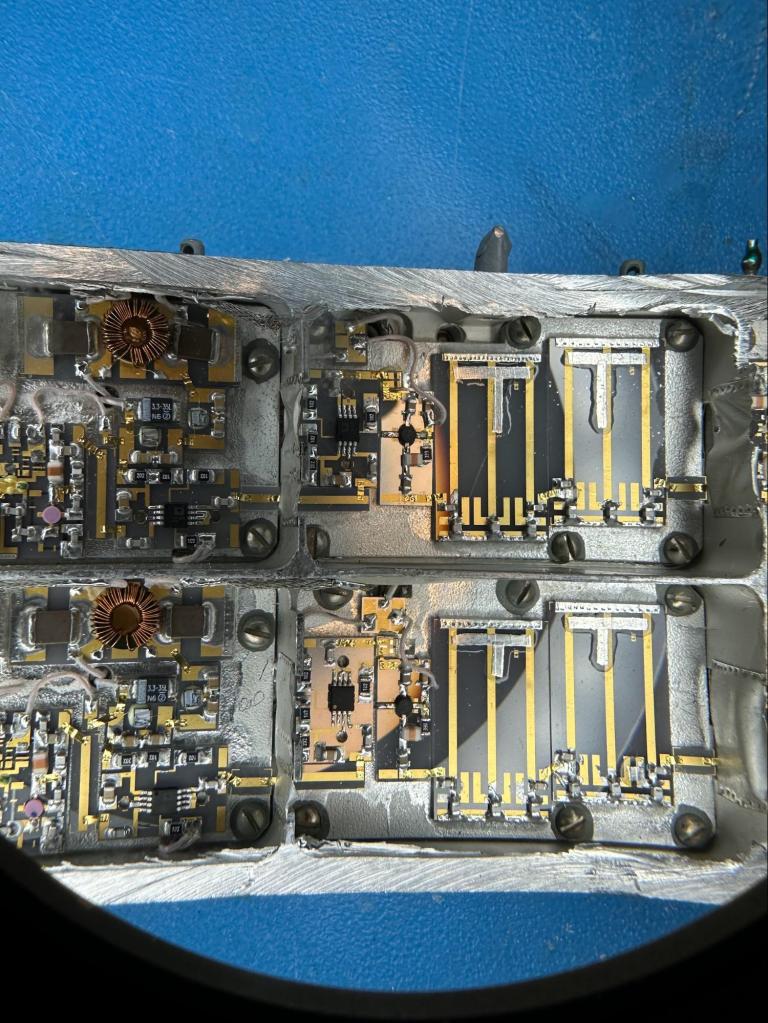
Let’s take a moment to admire it. If you look closely, each of those square PCBs are connected with metal foil (Figure 2). The wires protruding on the top are hand-soldered. The SOIC 8 in the middle is hand-soldered! The tin sleeves on the larger middle boards are tacked by hand! You can also see the shielding on the right side between the other cells that is hand-tacked. Those inductors also look quite inconsistent, meaning they may have been hand-wound.

On the green PCB in Figure 3, there is a trace in the middle that is routed to connect two points that are quite a ways away. This is very impressive. It is important to note that when designing and creating electronics, a prototype should be tested extensively to ensure the original design works properly, eliminating the need to route traces like this. However, it is still impressive to see that this was manually tacked into place on a production part. There are also a few ICs on the gray and gold board. The ICs are exposed and are a few hundred nanometers and thus visible to the naked eye. Let’s zoom into those a bit and take a peek.

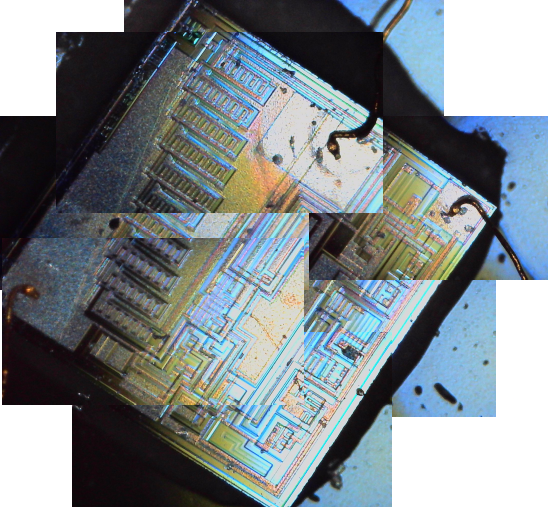
There is also another IC that is exposed on the device (Figure 6). This has 45 degree angle traces instead of right angles on the silicon.
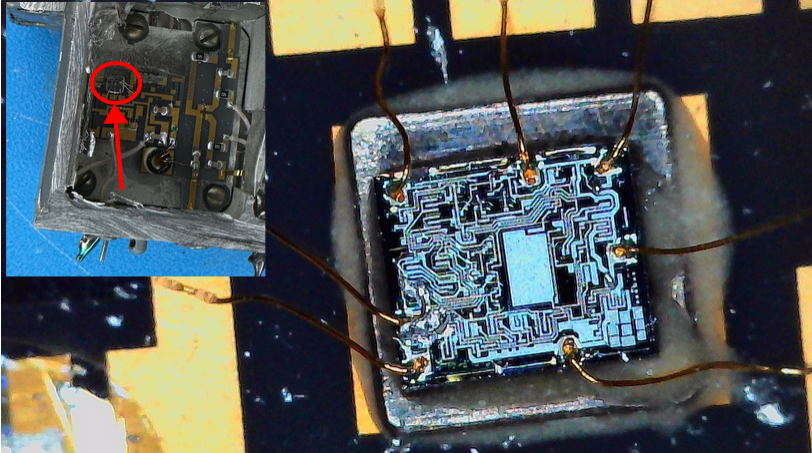

The ICs seem to all be hand-tacked or machine assisted. This is an extremely precise skill and takes lots of training and effort. While this entire process is inefficient and wasteful, the craftsmanship and effort that went into building this device is insane. This process must have taken time and very skilled engineers to put together. Figures 8 through 13 show more images to admire.

Figure 8: Oscillator that is glued in place and connected with wires to the PCB 
Figure 9: Electronic component that is glued in place as a module 
Figure 10: Traces bridged with metal hand-tacked and coated in clear solder mask or conformal coating 
Figure 11: Connection between two PCBs 
Figure 12: Hand-spun choke and traces 
Figure 13: Hand-placed trace for connecting components


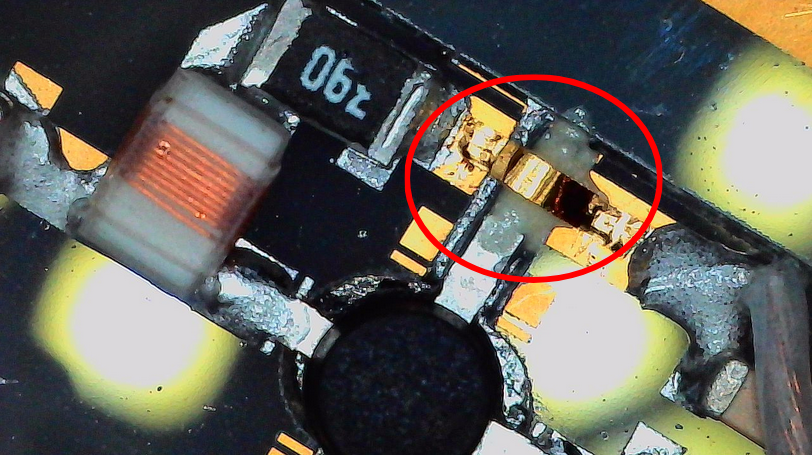


This amount of hand work is admirable. The craftsmanship is completely unnecessary but is beautiful. If this device actually functions it is an absolute miracle. Being handmade creates higher rates of failure and precision is lost as machines can be much more exact.
If you are interested in gaining the skills needed to build and fabricate electronic devices, I recommend you check out the OSH Park website. They are a great company for beginners and are based in the USA. They have a swift service and a few different PCB options so you can avoid connecting boards together by hand like the manufacturers of this part.
If you enjoyed this article, feel free to shoot me a message with your comments at hello@zetier.com. If you can provide any information on the device featured in this blog post, please let me know. I am dying to learn its backstory. Thank you for reading and see you next time!
Note: Zetier is not sponsored or endorsed by OSH Park.