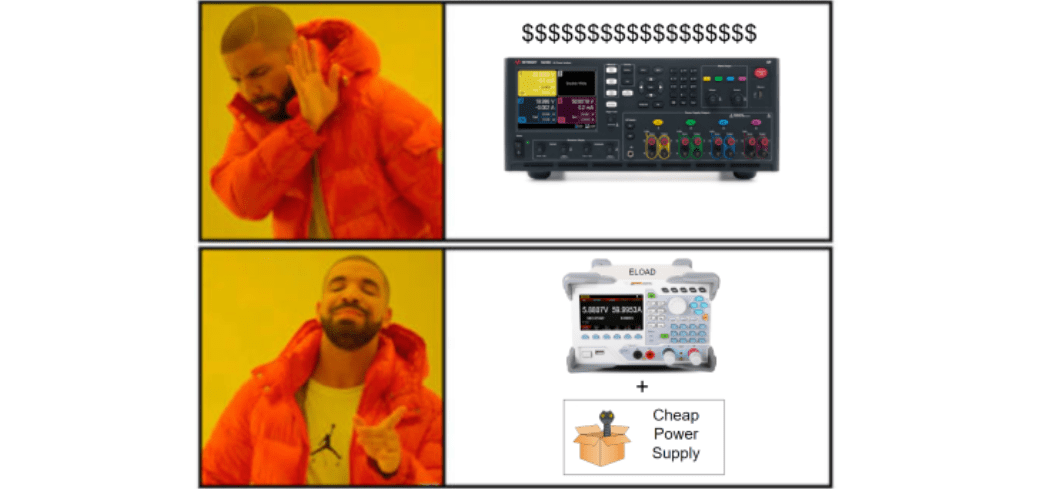
In cyber vulnerability research and reverse engineering, professionals frequently encounter hardware with specific power requirements not met by standard supplies. This dilemma often leads to considering high-end power supplies like the Keysight N7900 series, which comes with a price tag around $10,000. These premium units boast essential features such as overvoltage protection (OVP), overcurrent protection (OCP), slew rate control, current limiting, and power profiling—crucial for safeguarding the device under test.
However, there’s an innovative, budget-friendly alternative: combining a basic power supply with a smart electronic load, like the Rigol DL3021A (around $600). This method, using four-wire kelvin sensing, allows for integrating the electronic load with an economical power supply. The electronic load then replicates the protective and control functions of the more expensive units, providing OVP, OCP, and other features. This approach reduces costs and increases flexibility in situations where specialized power needs are prevalent.
The Challenge
Zetier regularly encounters hardware with unique power requirements. These devices require precision and flexibility in power delivery, ensuring optimal conditions for the device under test. An example scenario involves handling rack-mounted systems laden with a variety of electronics, often powered by an auxiliary power unit (APU). These APUs can supply hundreds of watts at DC line voltages around 50V. Finding a power supply that matches these requirements can be a challenge. The primary hurdles aren’t just technical compatibility; issues like limited physical space, availability, and the high cost of OEM equipment often present significant obstacles.
The open market does offer a plethora of stand-alone, single-output power supplies. Yet, when we receive them, we handle them more like a box of snakes than a reliable, well-regulated power source. Compare the cost of a 48V 10A single supply to the N6705, for example:


Despite the modest price of such a stand-alone power supply, around $30-$40 for a typical unit, the risk they pose is often too great. For example, risks of connecting a cheap power supply into a load include poor load regulation that can cause voltage fluctuations, inadequate thermal management potentially leading to overheating and device failure, and lack of overvoltage and overcurrent protection that can result in electrical surges damaging the load.
Professionals in this field are frequently forced to choose between being bitten by these unreliable supplies, investing in reliable and proven (although expensive) bench-top power supplies, or procuring the space-consuming, device-under-test-specific, OEM power supply.
Electronic Load
Enter the electronic load (ELoad). Typically used in battery testing and power electronics applications, ELoads offer a unique solution. By placing an ELoad in series with a basic, low-cost power supply, it’s possible to significantly mitigate the risks the cheap power supplies pose. The ELoad effectively acts as a gatekeeper, ensuring the power delivered to the device under test is stable, controlled, and within safe parameters. This approach not only protects the hardware but also introduces a level of versatility and cost-effectiveness previously unattainable with conventional power supply options.
The next section delves into the specifics of how this innovative interconnection is implemented to harness the full potential of the ELoad in such scenarios.
Application Background
In the world of power systems, one can use the Cartesian plane to depict power delivery, with voltage on the y-axis and current on the x-axis.

Conventional power supplies are designed to work in the first and third quadrants of this plane. In these domains, they are the givers, providing power with either positive or negative voltage and current, depending on the application. ELoads contrast this by residing in the second and fourth quadrants, where they consume, rather than provide, power. ELoads typically use large transistors to operate within a linear region, converting excess current into heat, which is then dissipated using substantial heat sinks—a fact that contributes to their size.
Application
By placing an ELoad in series with a power supply, it can effectively interrupt the supply. In normal operation, the ELoad absorbs virtually no current by producing a very low impedance on its outputs, smoothly passing power from the box of snakes into the device under test. Should the cheap supply fall out of regulation, the ELoad detects and responds by limiting exposure of the failed supply to the device under test.
In operation, with an ELoad in series with the cheap supply, we can employ overvoltage and overcurrent protection that will interrupt the supply in the event either it or the load fails. With the Rigol DL3021A in particular, we can further set power slew rates (to limit inrush) as well as graph the current in a time plot that also allows us to understand what the device under test is doing. With the four-wire kelvin sense enabled, we can directly view the line voltage of the cheap power supply as well as the current it’s supplying to the load. We can use the on/off button on the ELoad to disconnect and connect the power supply, effectively satisfying all requirements for a complete replacement of the power supply in terms of control, protection, and monitoring. We can even display the current profile over an adjustable period of time, giving us better insight into what the load is doing:

To have the ELoad properly measure the line voltage, we enable kelvin sense (four-wire) measurement found in the utility menu:

Below is an example application. In this scenario, we have a 48V power module feeding power to a “one-of-a-kind” device under test. We can enable power to the device by enabling the outputs of the ELoad, so we never have to handle the cheap power supply. With the Eload, current is interrupted by default, keeping the device under test unpowered in the event the ELoad loses power, gets shut off, or even power cycles. Only until the user selects the button that enables the Eload’s output will current be allowed to flow to the device under test. Settings can be saved and restored.
In addition to the 4-wire sense option, we also set the operational mode of the supply to Constant Current and lift the current limit to beyond the limits the supply requires. This guarantees we achieve as-low-as-possible impedance between the output terminals. We can also set limits on overvoltage (as measured from the 4-wire sense) and overcurrent (which can be lower than the CC set current). We also have the option of constrained current profiles, which are not available even with the most expensive supplies—for example, when performing VR work on a system, we could enforce complete power-cycles periodically that could assist in fuzzing operations with minimal setup to the test environment.

Conclusion
The deployment of an electronic load (ELoad) in series with an inexpensive power supply is a great choice for any budget hardware testing setup. It presents a cost-effective, space-efficient solution that provides advanced protective features like overvoltage protection (OVP) and overcurrent protection (OCP). These features ensure protection for the device under test. By embracing the use of an ELoad, engineers and researchers can achieve high precision in power control and protection, enhancing the reliability and integrity of their testing procedures without incurring the substantial costs associated with high-end power supplies.


